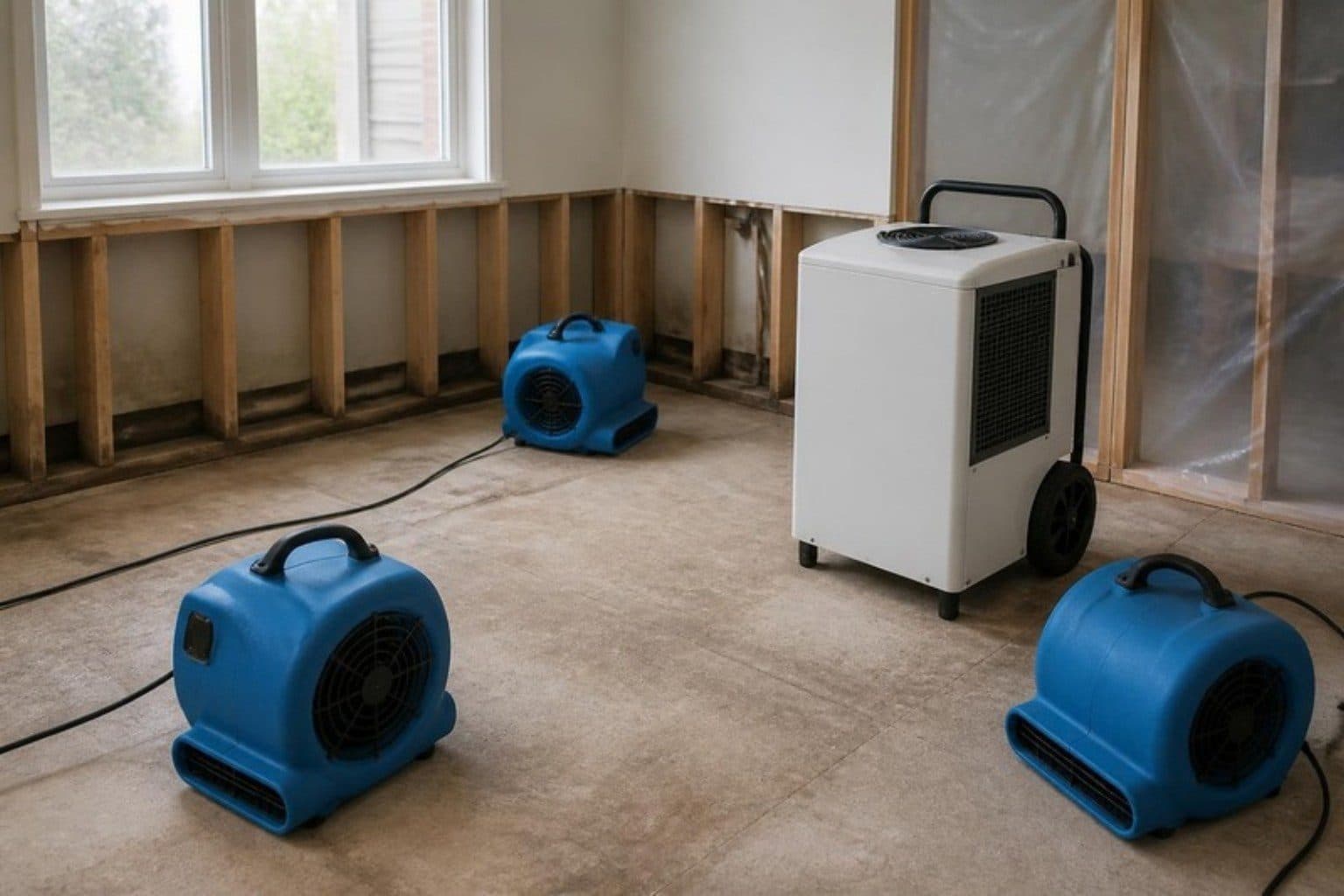
Drying a basement is not the same as making it look dry. Carpet can feel dry to the touch while the underpad and slab below are still wet, and drywall can look fine while the framing behind it holds water. Professional drying, done to the IICRC S500 standard, targets the moisture inside materials, not just the surface. That is why the timeline is measured in days rather than hours, and why the equipment stays even after the room feels normal. Below are typical timelines, what changes them, and how the end point is measured.
How long does drying take by scenario?
| Scenario | Typical drying time | Notes |
|---|---|---|
| Clean water on concrete or tile, extracted the same day | 2 to 3 days | Fastest case; little to remove |
| Clean water in a finished basement, caught within hours | 3 to 5 days | Wet drywall may be dried in place if caught early |
| Grey or black water, or water that sat 24 hours or more | 4 to 7 days after tear-out | Porous materials removed first, then the structure is dried |
| Hardwood flooring | Often 7 to 14 days | Specialty drying mats; not always salvageable |
| Saturated concrete slab or block walls | A week or more | Concrete absorbs water and releases it slowly |
| Class 4 loss (dense or layered materials) | Often 7 to 14 days or more | Specialty low-humidity or heat drying |
What happens on each day of drying?
Day 0: extraction and setup
The crew arrives, confirms the water is stopped and the power is safe, and classifies the loss by category and class. Standing water is removed with truck-mounted or portable extractors. Materials that cannot be dried, such as carpet underpad in Category 3 water or drywall that has been wet for days, are removed. The crew takes moisture readings of every affected material and of an unaffected reference area, then places air movers and dehumidifiers. The number of units depends on square footage, wall area and the class of the loss.
Days 1 to 3: evaporation and dehumidification
Air movers push dry air across wet surfaces so moisture evaporates. Dehumidifiers pull that moisture out of the air so it cannot settle back into materials. The crew returns daily to take readings, adjust equipment and check for hidden moisture behind baseboards and inside wall cavities. Most of the free water in drywall and framing leaves during this window. The room often feels dry by day two, but the readings show the materials are not there yet.
Days 3 to 5: reaching the dry standard
Drying slows as materials approach their normal moisture content. This is where patience pays off. Readings are compared against the dry standard set on day 0. When wood framing, drywall and subfloor match the reference area, and humidity in the space is stable, the equipment comes out. A final report lists the readings, the equipment used and the days on site, which is what your adjuster expects to see.
What slows drying down?
- Hardwood and engineered wood floors, which swell and hold water in the tongue and groove joints
- Concrete slabs and block walls, which absorb water and release it slowly
- Multiple flooring layers, such as vinyl over plywood over an older floor
- Insulation inside finished walls, which stays saturated unless the drywall is opened
- Cold weather, which lowers evaporation rates and makes the basement harder to warm
- High outdoor humidity in summer, which limits how much open windows help
- Delays before the call, since water that sat for days has migrated further into the structure
- Turning off equipment overnight to save power, which can add a day or more to the schedule
The IICRC S500 groups losses into classes based on how much water is present and how hard the materials are to dry. Class 1 affects a small area with little absorption. Class 2 involves more wet material, such as a full room with wet carpet and walls. Class 3 means water came from above and saturated ceilings, walls and floors. Class 4 covers dense or layered materials such as hardwood, plaster, concrete and brick, which need specialty drying and the longest timelines. Most basement floods in Toronto fall into Class 2 or 3, with Class 4 elements where hardwood or concrete is involved.
Air movers and dehumidifiers are loud, and it is tempting to shut them down at night. Doing so lets humidity climb and moisture migrate back into drywall and framing. It also breaks the moisture log your adjuster relies on. The cost of the electricity is small compared to a day of extra equipment rental or a mould problem later.
How do you know when a basement is actually dry?
A basement is dry when the materials return to their normal moisture content, not when they feel dry. Professional crews measure this with pin and pinless moisture meters on drywall, wood and subfloor, and with thermo-hygrometers for air temperature and humidity. Before drying starts, readings are taken in an unaffected area to establish the dry standard for that house. Drying is complete when affected materials match that standard, typically within a few percentage points, on consecutive readings.
Ask for the moisture log at the end of the job. It should show the starting readings, daily progress and final readings for each material and location. If a company cannot show you readings, they are guessing. RapidDry Restoration provides the log and photos to your adjuster as part of the claim file, and it also protects you if a question about mould comes up months later.
What happens after the basement is dry?
Drying is the middle of the process, not the end. Once the structure is dry, the rebuild can start: new drywall and insulation, paint, trim and flooring. Rebuild Pro Contracting handles that phase, and on an insured claim the adjuster approves it as a second scope. If the flood came through the foundation or from a failed sump, DryFort Waterproofing can address the root cause so the drying does not have to be repeated next spring. Mould prevention treatment before the walls are closed is a sensible step in any basement that was wet for more than a day.
Frequently asked questions
Can I speed up drying with my own fans and a dehumidifier?
Household fans and a small dehumidifier help with surface moisture but cannot dry inside walls or under flooring. Commercial air movers move far more air, and low-grain refrigerant dehumidifiers pull moisture at rates a consumer unit cannot match. Using your own equipment while waiting for the crew is fine. Relying on it instead of professional drying usually means hidden moisture and mould later.
Why is the crew still here when everything feels dry?
Surfaces dry first. Framing, subfloor and the back of drywall dry last, and they are where mould starts. The crew stays until meter readings on those materials match the dry standard for your house. Pulling equipment early is the most common cause of a second call-out for mould a few months later.
Does the drying timeline change in winter?
Yes. Cold basements slow evaporation, and the crew may add heat to bring the space into the temperature range where dehumidifiers work efficiently. Winter also brings more frozen pipe losses, which often go unnoticed for longer and involve larger volumes of water. Expect timelines toward the longer end of each range from December through March.
How long before mould starts growing?
Mould can begin growing on wet drywall, wood and paper within 24 to 48 hours at typical basement temperatures. That is why extraction and equipment setup on day 0 matter more than any other step. If water sat for more than two days before drying started, an antimicrobial treatment and removal of porous materials are usually part of the scope.