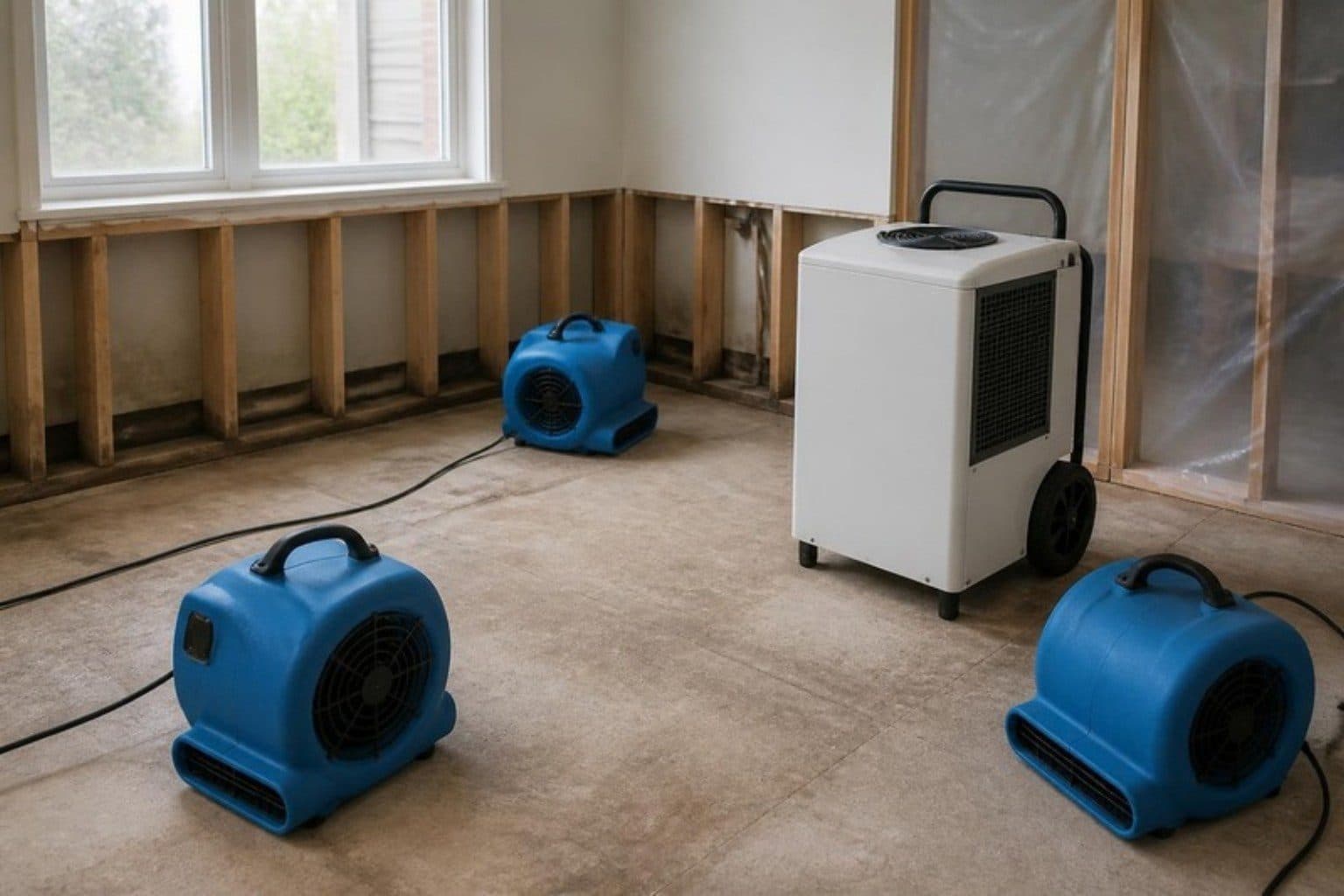
Extraction removes the water you can see. Drying removes the water you cannot: the moisture held in drywall, subfloor, framing, concrete and insulation. That absorbed moisture is what feeds mould, warps hardwood, delaminates subfloor and causes the musty smell that shows up weeks after a flood was supposedly handled. Structural drying is the part of the job that determines whether the loss is truly over.
Drying is a measured process, not a matter of leaving fans running until things look fine. We take baseline readings in every affected material, set a dry standard based on unaffected areas of the same house, size the equipment to the space and the moisture load, and return daily to log progress. Equipment comes out when the numbers say so.
We provide drying as part of every emergency call and as a standalone service for homeowners and contractors across Toronto, North York, Scarborough, Etobicoke, Mississauga, Vaughan, Thornhill, Richmond Hill and Markham. Our drying process follows the IICRC S500 standard, and every job closes with a drying log your insurer can read.
What we do on site
- Take baseline moisture readings in every affected material and a reference reading in an unaffected area to set the dry standard.
- Calculate the moisture load and size the air movers and dehumidifiers to the space, not just place a few units and hope.
- Position air movers for surface airflow across every wet surface and set dehumidifiers to pull moisture from the room air.
- Use specialty equipment where needed: floor mat systems for hardwood, injection drying for wall cavities, desiccants for cold spaces.
- Return daily to log readings, temperature and humidity at marked points, and reposition equipment as areas dry.
- Confirm every monitored point meets the dry standard, then remove equipment and photograph the finished space.
- Deliver a complete drying log to you and your insurer and hand off to Rebuild Pro Contracting for reconstruction.
How long does it take to dry out a house after water damage?
Most residential water losses in the GTA dry in 3 to 5 days once extraction is done. Class 1 losses, where only a small area is wet and materials are low-porosity, can dry in 2 days. Class 2, the most common, with carpet, drywall and some wicking up walls, is the 3-to-5-day range. Class 3, where water came from above and saturated ceilings, walls, insulation and floors, often runs 5 to 7 days. Class 4 involves dense materials like hardwood, plaster and concrete that hold water tightly and can take 7 to 14 days with specialty equipment.
What extends drying is wet material left in place, high humidity from the weather, and poor airflow in enclosed cavities. What shortens it is thorough extraction, prompt tear-out of what cannot be saved, and properly sized equipment.
- Class 1: small area, low porosity materials, about 2 days
- Class 2: carpet, drywall, wicking under 60 cm, 3 to 5 days
- Class 3: saturated from above, ceilings and walls, 5 to 7 days
- Class 4: hardwood, plaster, concrete, 7 to 14 days with specialty drying
What equipment do you use and why does it matter?
Air movers push a fast, thin layer of air across wet surfaces, which lifts moisture off the material into the room air. Dehumidifiers pull that moisture out of the air so the room does not simply become saturated and stop drying. The two must be balanced. Too many air movers with too little dehumidification just circulates humid air. We use low-grain refrigerant dehumidifiers for most residential work and desiccant units when the space is cold or the target humidity is very low.
For hardwood floors we use mat systems that pull air through the boards from above. For wall cavities we use injection drying, which forces air behind the drywall through small holes at the baseboard line. HEPA air scrubbers run when the loss involved contaminated water or when tear-out produced dust.
How do you know when a house is actually dry?
We compare readings to a dry standard, not to a feeling. Before drying starts we take a reference reading in an unaffected part of the house, in the same material, to learn what dry means for that house. Drywall in a Toronto home in September will read differently than drywall in February. Then we set the drying goal as that reference plus a small margin, and take readings at the same marked points every day until every point hits the goal.
The result is a drying log with dates, locations, readings, equipment counts and temperature and humidity. It is the document that proves to the insurer, and to you, that the structure was dried properly before it was closed up.
Can I just run fans and a dehumidifier myself?
For a small spill on a hard floor, yes. For a real water loss, no. A household dehumidifier removes a fraction of what a commercial unit does, and consumer fans do not create the surface air speed needed to dry drywall or subfloor. More importantly, without a moisture meter you have no way to know if the framing behind the wall is dry. Homes that were dried by eye are the ones that come back to us months later with mould behind the baseboard.
Do you need to keep the equipment running the whole time?
Yes. Drying is continuous, and switching equipment off overnight can add a day or more to the timeline because materials re-absorb moisture from the air. The equipment is loud, roughly the level of a vacuum cleaner, and it uses electricity. The electricity used over a typical 4-day dry is modest, and that cost is claimable. We place equipment to minimize disruption where we can, and we tell you up front how long it will run.
When the water source is covered, structural drying is part of the claim on Ontario home policies, including equipment rental, daily monitoring and the electricity used. Insurers want to see a drying log with daily readings, because it proves the work was necessary and complete, and it protects them from a later mould claim. If drying is done without that record, adjusters commonly reduce the number of days they will pay for. We provide the full log on every job and bill your insurer directly through a Direction to Pay.
Frequently asked questions
How many days will the drying equipment be in my house?
Three to five days for most water losses. Two days for small clean-water losses on hard surfaces. Up to two weeks when hardwood, plaster or thick concrete is involved. We tell you the expected timeline on day one based on the class of loss and update it at every daily monitoring visit.
What is the difference between an air mover and a regular fan?
An air mover is designed to push a high-velocity sheet of air along a surface, which is what pulls moisture out of drywall and flooring. A household fan moves a lot of air but slowly and in every direction. One air mover does the surface drying work of many box fans, and it is built to run continuously for days.
Can hardwood floors be saved after water damage?
Often, if drying starts within a day or two and the boards have not cupped severely. Floor mat systems pull air through the boards and can bring them back to normal moisture content over 7 to 14 days. Boards that have buckled, split, or been under Category 3 water are replaced. We assess this on the first visit and tell you which way it is likely to go.
Does drying get rid of mould?
Drying stops mould from starting and growing, because mould needs moisture. It does not remove mould that has already grown. If drywall or framing already shows visible growth, it is treated or removed as part of remediation before drying is completed. Fast drying within the first 48 hours is the best way to avoid needing remediation at all.
Do you dry concrete basements too?
Yes. Concrete absorbs a surprising amount of water and releases it slowly. A slab that looks dry on the surface can still read wet with a meter. We dry the slab to standard before any flooring goes back down, because installing flooring over a wet slab is a common cause of flooring failure and mould under the new floor.